bbdbuy Standing Shoe Collar Edge: Reduce Ankle Friction
bbdbuy Standing Shoe Collar Edge: Reduce Ankle Friction
bbdbuy Standing Shoe Collar Edge: Reduce Ankle Friction
Whether a pair of standing commuter shoes is likely to rub your ankles cannot be judged solely by the upper material or product title. What really needs to be verified is how the shoe collar edge, lining, and padding layer are connected, and what impact these structures may have during ankle movement and prolonged pressure.
This guide tackles one specific task: using the product information and QC photos on bbdbuysheets.net to determine whether the shoe collar structure has an obvious friction risk. After reading, you should be able to complete a structural check, know which evidence can be confirmed from photos, and which issues must be clarified with the seller or purchasing agent.
This article is not intended for diagnosing foot conditions and cannot replace actual try-on. Photos cannot prove that the shoe collar is definitely soft, fits well, or won't rub at all. 🩺
Clarify the Task of Judging Shoe Collar Edge and Ankle Friction
The shoe collar edge is the structure used to finish, bind, and stabilize the shape of the opening edge of the shoe upper. It typically works together with the collar lining, foam, or other padding layers to determine the hardness, thickness, and edge pressure that contacts the ankle.
During prolonged standing or commuting, friction risks generally come from the following situations:
Inconsistent collar edge width, with a certain small section noticeably narrower or thicker
Exposed edge stitching, binding tape, or cut edges forming localized hard spots
Different collar heights on the left and right shoes, causing higher pressure on one ankle
The lining turning outward, bunching, or having unsecured wrinkles at the collar
The padding layer breaking under the collar edge, making the edge suddenly feel harder
The collar height landing right on the ankle bone protrusion, causing repeated rubbing while walking
Therefore, the key judgment is not "does this shoe look soft," but "is the collar contact area continuous, even, symmetrical, and free of obvious localized pressure points." 🔍
Understand the Visible Structure of the Collar, Lining, and Padding Layer
When viewing product photos or QC photos, you can first divide the shoe collar into three areas:
Outer edge: the binding strip, edging, or stitching area visible from the outside of the upper.
Contact lining: the part closest to the ankle skin or sock when worn.
Padding layer under the edge: foam, cushioning, or layered materials used to support the collar shape.
Evidence that can be relatively reliably observed in photos includes:
Whether the edge completely covers the shoe collar opening
Whether the stitching is continuous and whether there are obvious interruptions in stitch length
Whether the collar height, curvature, and width of the left and right shoes are roughly consistent
Whether the lining is pressed down by the edge and whether there is obvious outward turning
Whether the padding layer suddenly collapses or bulges at some point
Whether there are protruding thread ends, hard creases, or unusually thick lumps along the collar edge
Photos cannot reliably prove the following:
The actual softness of foam or lining
Resilience and deformation after hours of wear
Individual skin reactions to materials, dyes, or adhesives
Whether the shoe size perfectly matches actual foot length and instep height
Whether the heel slips during walking and repeatedly pulls the collar
Treating "looks flat" as "definitely won't rub when worn" is one of the most common misjudgments in shoe photo inspection. ⚠️
Check Edge Continuity and Left-Right Symmetry from Product Photos
It is recommended to first look at the overall shoe collar, then zoom in on details. Don't focus only on the clearest photo at the beginning, because a certain angle may obscure the lining or stitching.
You can check in the following order:
First confirm whether both shoes appear in the same set of photos
Compare the four positions: front, outer side, heel, and inner side of the collar
Observe continuously along the edge for sudden narrowing, thickening, or interruptions in curvature
Check whether the stitching is evenly distributed along the edge
Inspect the connection between the edge and the upper for gaps, lifting, or obvious misalignment
Compare the highest point and heel opening height of the left and right collars
If the product photos only show one shoe, fixed angles, or insufficient resolution, the conclusion should be limited to "unable to complete left-right symmetry verification" rather than directly judging it as qualified.
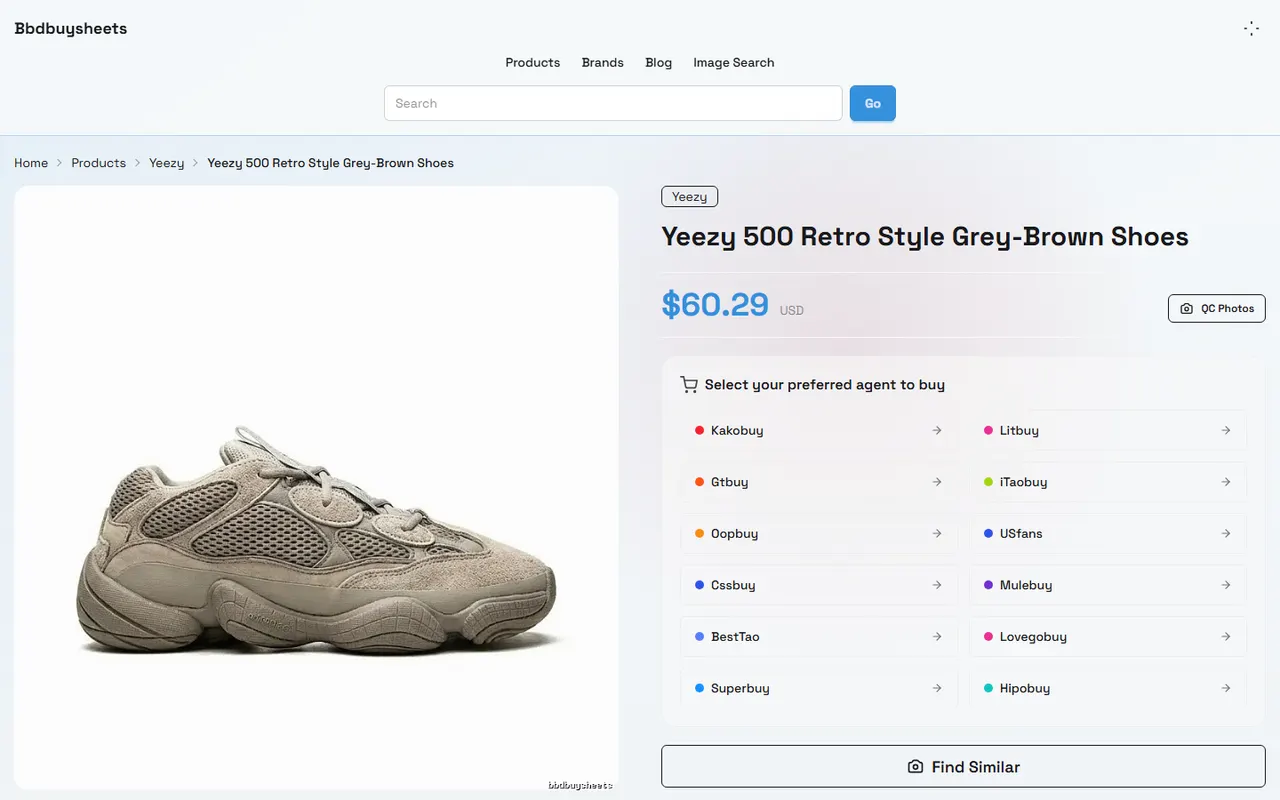
For product information on bbdbuysheets.net, the page can display product name, price, QC Photos, and purchasing process details such as selecting a purchasing agent. Taking the product page sample verified this time as an example, the page shows product images and a QC Photos entry, but such page information alone cannot replace close-up supplementary shots of the shoe collar edge. 🛒
Distinguish Pressure Marks, Wrinkles, and Structural Abnormalities from QC Photos
Minor pressure marks in QC photos do not necessarily indicate quality issues. Shoes may develop temporary creases during packaging, shipping, or when positioned for photography. The key to judgment is whether the marks occur together with structural abnormalities.
You can refer to the following distinction methods:
Observed Phenomenon | More Likely Explanation | Evidence to Confirm |
|---|---|---|
The edge is generally continuous, only a shallow crease on the midfoot upper | Temporary pressure mark from packaging or positioning | Close-up photo after re-opening the collar |
Wrinkles concentrated along the stitching, accompanied by edge lifting | Uneven binding tension or stitching | Same-angle photos of both inside and outside of the collar |
A small section clearly thicker than the rest | Padding layer stacking or localized hard spot | Video of deformation and rebound after pressing by hand |
Obvious difference in collar curvature between left and right shoes | Differences in last, production, or shipping deformation | Both shoes side by side, front and heel views |
Thread ends, cut edges, or lining persistently exposed | Incomplete finishing or insufficient fastening | Enlarged photo to confirm if it can be trimmed and whether it affects the contact area |
If a pressure mark remains in the same position and depth from multiple angles and the collar curvature is also distorted, it should not be simply categorized as packaging marks.
Assess Fit Risk by Sock Height and Work Hours
The same shoe collar structure poses different risks to different wearers. Sock height, ankle bone position, instep height, and daily standing hours all change the contact area.
You can do a preliminary risk grading as follows:
No-show or low-cut socks: ankle directly contacts the collar, most important to watch for hard spots and thread ends
Crew socks: can reduce direct skin friction, but the sock cuff itself may overlap with the collar and create pressure
Thick socks: may cushion edge friction, but also reduce in-shoe space, increasing pressure on instep and collar
Short daily standing time: minor structural differences may not quickly cause discomfort, but still need to watch for localized hard spots
Standing continuously for several hours daily: should raise requirements for collar height, heel slippage, and left-right symmetry
Prominent ankle bones or history of friction sensitivity: should prioritize products that can provide close-up structural evidence
Do not solve collar friction by blindly buying a larger size. Oversizing may increase heel slippage, causing the collar to repeatedly rub the ankle during walking. 👟
Softness and Actual Rubbing That Cannot Be Confirmed from Photos
Photos can only provide structural clues, not direct proof of wearing comfort. The following judgments must be made with caution:
"Looks like there is foam" does not mean the foam is soft enough
"Thick edge" does not mean better cushioning; excessive thickness can also form a pressure point
"No visible thread ends" does not mean the stitching won't rub during long walks
"Collar is symmetrical" does not mean the last fits your ankle position
"QC photos show no problems" does not mean every pair shipped by the seller is identical
If the platform provides QC photos, treat them as pre-shipment sample evidence, not as a personal try-on report. This article also did not conduct actual ordering, receiving, or wearing tests, and product page photos cannot be written as real experience.
Items to Clarify or Request Before Ordering
When the shoe collar is your primary concern, it is recommended to request the following before ordering or confirming shipment:
Both shoes placed side by side, photographed from front, outer side, inner side, and heel views of the collar
Close-up of the connection between edge and lining
Continuous edge after the collar is stretched open, avoiding only showing the naturally collapsed state
Confirm whether there are thread ends, glue separation, lifted binding, or obvious hard creases
Ask about the approximate material and thickness of the collar padding layer; do not let the seller use vague words like "soft" instead of a description
Ask about collar height and measurement method, preferably provide dimensions in a flat or fixed state
Compare whether the left and right collars are from the same pair and confirm the photos are not of another sample
If the other party can only provide long-distance photos or refuses to take close-ups of key contact areas, the risk should be marked as "insufficient evidence" rather than assuming there is no problem.
The bbdbuysheets.net page shows that you can enter QC Photos through the product page and select different purchasing agents to complete the subsequent purchase process. Actual costs, stock, size options, agent service fees, and shipping conditions should still be re-verified before ordering, and should not be judged solely from search summaries or old screenshots. 📦
Final Action: Create a Shoe Collar Structure Verification Checklist
Before ordering, you can copy the following checklist and record each item as "Confirmed," "Need supplementary photos," or "Cannot confirm":
Verification Item | Result Record | Action if Failed or Lacking Evidence |
|---|---|---|
Does the edge continuously cover the collar opening | Confirmed / Need photos / Cannot confirm | Request close-ups from four sides of the collar |
Are left and right collar heights and curvatures roughly consistent | Confirmed / Need photos / Cannot confirm | Request both shoes side by side |
Are there localized hard spots from stitching, thread ends, or binding | Confirmed / Need photos / Cannot confirm | Request enlarged photos of contact area |
Is the lining turned outward, bunched, or detached from the edge | Confirmed / Need photos / Cannot confirm | Request lining photo after stretching open the collar |
Does the collar position conflict with sock height and ankle bone | Evaluated / Not evaluated | Compare with your own sock height and work hours |
Softness and long-term rubbing risk | Cannot confirm from photos | Do not take product photos as try-on conclusion |
The direct purchase amount saved by this judgment is $0, because collar structure verification itself does not generate calculable shipping discounts; it saves potential costs of wrong purchases, returns, and long-term discomfort. If you need to compare combined shipping, split shipping, or logistics options, you should separately verify weight, volume, service fees, route restrictions, and destination taxes, and cannot estimate savings from collar photos.
This method is suitable for buyers who need to stand for long periods, have long commutes, are sensitive to ankle friction, or want more product evidence before confirming shipment. It is not recommended to order based solely on long-distance product photos, single-shoe photos, or vague descriptions like "comfortable" or "soft sole"; if the seller cannot provide basic evidence of the collar contact area, you should delay the purchase decision or choose a product with more complete information.
Agent Platform Shopping FAQ
1. How do I find the item I want to buy on bbdbuysheets.net?
You can search using individual keywords, or browse category pages where items are also organized by brand. Longer search terms usually yield fewer but more accurate results. For example, you could search "Air Force 1 White," "sneakers," or just "Air Force 1."
2. What kinds of items can I buy from the bbdbuysheets.net spreadsheet?
The platform spreadsheet covers shoes, clothing, bags, accessories, jerseys, perfumes, hats, scarves, belts, and various household goods.
3. What should I pay attention to when using an agent platform for the first time on bbdbuysheets.net?
First-time Taobao agent users generally receive a new-user shipping discount package. At the same time, you should check the step-by-step beginner's shopping tutorial guide.
Browse our latest products and find your next favorite item.