bbdbuy Rain Commuter Shoe Guide
bbdbuy Rain Commuter Shoe Guide
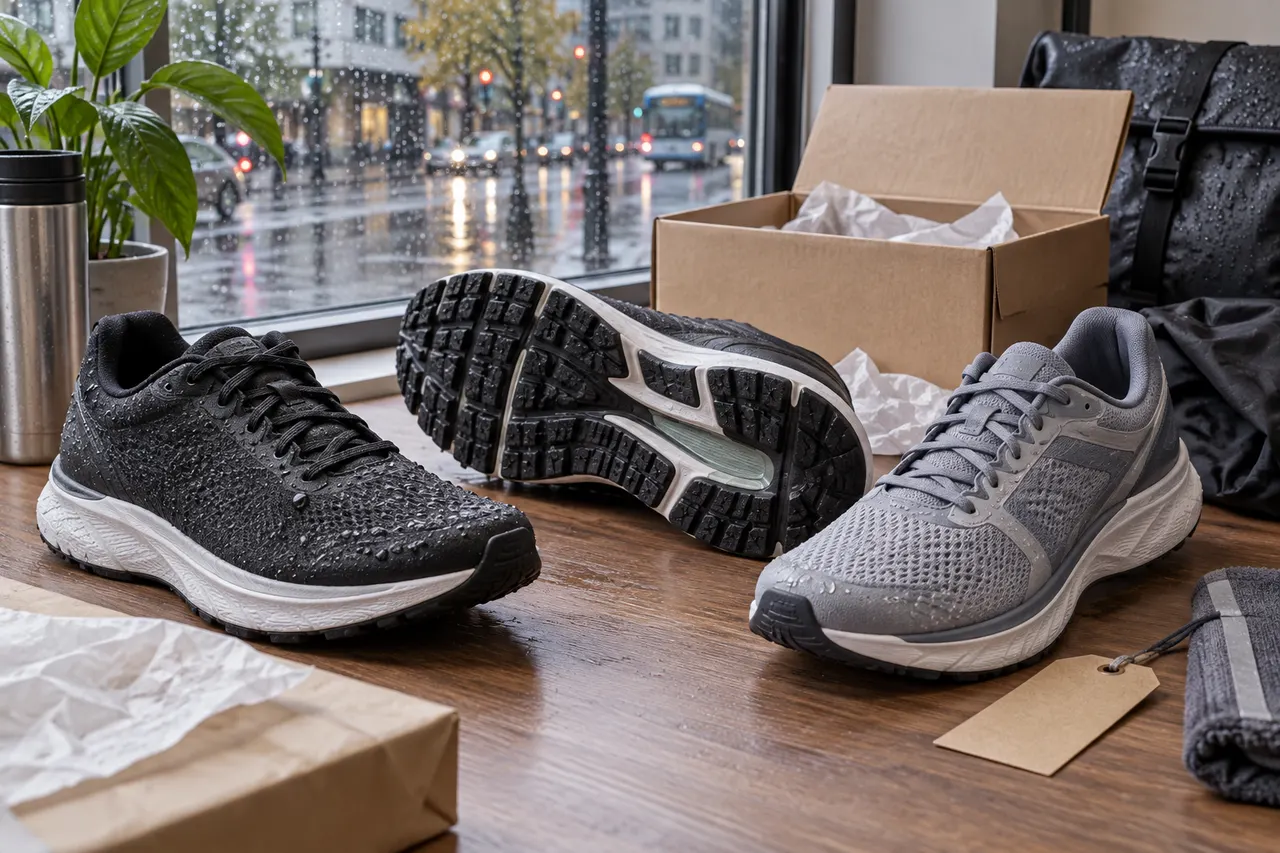
Choosing a running shoe for rainy commutes isn't just about finding a "waterproof shoe." What really matters is whether the ground will be slippery, whether the upper will feel stuffy, whether water will get in around the collar, and whether the outsole and shoe body look stable in QC photos. This article is for users who are already prepared to use bbdbuysheets.net to find shoe models and make judgments based on product pages and subsequent inspection photos; it is not suitable for people who need professional trail running, flood wading, standing in water for long periods for work, or who treat running shoes as fully waterproof rain boots.
Verification date: September 8, 2026. This article does not use unverified prices, stock, seller promises, or real wear experience conclusions. Before ordering, still use the product page, agent ordering page, warehouse QC photos, and destination logistics rules as the standard.
First confirm the actual road conditions for rainy commuting
Don't start by selecting based on shoe name; start by judging from the road surfaces you pass every day. The most common problem in rainy commuting is usually not whether the shoes "can run," but whether they are stable during morning rush turns, entering the subway, climbing stairs, and stepping on smooth brick surfaces.
You can divide your route into several categories:
Light rain and asphalt roads: focus on outsole drainage patterns, upper quick-drying ability, and shoe weight.
Subway platforms, mall tiles, stairs: focus on outsole contact area, pattern direction, and heel stability.
Waterlogged sections after rain: focus on upper opening size, tongue coverage, and collar height.
Cycling or long-distance walking commute: focus on shoelace fixation, forefoot flexibility, and heel wrap.
Long wear in the office: focus on breathability, drying speed, and whether it easily feels damp and stuffy.
If your commute route has many glossy tiles and metal ramps, anti-slip priority should be higher than so-called "lightweight." If you only occasionally walk on asphalt in light rain, breathability and drying speed are more important. 🌧️
Define the scope of judgment that product pages and images can support
On tabular product discovery websites like bbdbuysheets.net, users usually first filter shoe models through tables or product listings, then jump to corresponding product information or agent purchase processes. What can be done here is to initially exclude shoes that are obviously unsuitable for rainy commutes, but not to prematurely conclude that a certain pair is definitely anti-slip, definitely waterproof, or definitely authentic.
Product pages and images usually support these judgments:
Whether the upper has large areas of mesh, heat-melted overlays, leather, or synthetic material zones.
Whether the outsole pattern is shallow flat, blocky, wavy, or almost completely smooth.
Collar height, whether the tongue easily flips outward, and whether the lace holes are stable.
Whether there is obvious risk of sole separation at the connection between the sole and upper.
Whether the shoe shape is narrow and whether the toe box is easily wetted by rain.
Product pages and images cannot reliably support these judgments:
Actual wet surface friction coefficient.
Internal drying time after prolonged rain exposure.
Whether different sizes are completely consistent.
Whether seller inventory is real-time accurate.
Durability and odor performance after arrival.
So the reasonable process should be: first use the product page for directional screening, then use warehouse QC photos for structural review, and finally decide whether to continue shipping based on destination weather, logistics time, and return window.
Look at outsole patterns for wet slippery ground, stairs, and subway platforms
The core of outsole selection for rainy commuting is to have enough contact and drainage on wet slippery surfaces, and not just look at whether the pattern "looks aggressive." Patterns that are too deep, too hard, or too sparse are not necessarily better in urban commuting; outsoles that are too flat, too shallow, or too smooth are also prone to losing grip on tiles and platform edges.
Road condition | Outsole features to prioritize | Features to be cautious about |
|---|---|---|
Wet asphalt road | Continuous pattern, drainage grooves in forefoot flex zone, heel landing area not completely smooth | Large flat bottom, pattern only concentrated in decorative areas |
Subway platform and mall tiles | Even contact surface, pattern not too hard, detailed zones on both forefoot and heel | Hard smooth bottom, narrow and high heel |
Stairs and overpasses | Stable heel edge, obvious lateral support pattern on forefoot | Rounded sole edges, unstable heel flare |
Waterlogged sidewalks | Outsole has drainage space, lower edge of upper covers more completely | Large-hole mesh extends directly to toe box and sides |
When looking at images, you can enlarge the outsole area to check whether both forefoot and heel have functional patterns. Some midsoles look complex, but the actual contact edges of the forefoot and heel are flat, which is not necessarily stable when turning at subway entrances in the rain. 🚇
If the product images do not have clear outsole photos, it is recommended not to order based only on upper aesthetics. Lack of outsole information for rain commuting shoes means lack of the most critical evidence.
Compare upper protection, breathability, and drying time trade-offs
Many users interpret "waterproof" as the more sealed the better, but commuting running shoes need to balance protection and breathability. A fully sealed upper may block light rain, but it may also make your feet stuffy in the office; a large mesh upper dries quickly, but water is more likely to enter when walking through puddles.
A more practical judgment is to look at the upper zones:
Toe box front edge: should have some coverage to prevent rain from directly entering the toe area.
Side midfoot: can retain breathability, but large-hole mesh will be more prone to water seepage in rain.
Tongue area: if the tongue is too thin and there is no cover on both sides, rainwater will enter through the lace gaps.
Heel area: if heel support is too soft, it will easily wobble when walking fast in rain.
Upper lower edge: if the openings near the midsole are too large, water will enter more easily when stepping in puddles.
If you only walk 10 to 15 minutes a day and can accept slight wetness in light rain, breathable uppers are more comfortable. If one way takes more than 30 minutes and you often encounter puddles, prioritize styles with more complete toe and side coverage.
Don't equate "thick upper" with "good rain shoe." Once thick materials get soaked, drying time may be longer and more likely to affect wear the next day.
Check collar, tongue, and laces for water entry or looseness
Water enters the shoe often not from the sole, but seeps in from the collar, tongue, and lace area. If the product images only show side and front views, you need to additionally look at top view or QC photos.
Before ordering, focus on three areas:
Is the collar height too low. Low-top running shoes are more flexible, but there is an easy water entry point between pant leg, sock opening, and collar.
Is the tongue centered and wide enough. If the tongue is too narrow, the gaps on both sides of the laces are more obvious.
Is the lace system secure. When walking fast or rushing in rain, loose laces increase the risk of slipping.
For commuters, lace hole placement is more important than decorative laces. Clear lace holes, natural force direction, and stable tongue position usually lead to more stable daily experience. 👟
If the product images show particularly thin tongue, low collar, and large mesh extending to the lace area, these shoes are more suitable for sunny days or short distances and not recommended as primary rain commuting shoes.
Use QC photos to check outsole adhesion, left-right shoe shape, and glue traces
After ordering through the bbdbuy related purchase process, warehouse QC photos are a key step for reviewing rain commuting shoes. QC photos cannot replace actual wear testing, but they can help you spot obvious structural problems and avoid continuing to ship higher-risk shoes overseas.
After receiving QC photos, check in this order:
Look at whether the outsole edge is adhered. Focus on the toe, heel, and side corners for obvious gaps or lifting.
Look at whether the left and right shoe shapes are symmetrical. Be cautious if toe height, heel slope, or upper lines differ too much.
Look at whether glue traces are abnormal. Minor glue marks may just be craft traces, but large overflow, openings, or uneven edges need re-inspection.
Look at whether the outsole pattern is complete. Confirm that the left and right pattern depth, direction, and wear are consistent.
Look at the shoe box, hang tag, and size marking. Not to determine authenticity, but to reduce the risk of wrong size or wrong product.
If the QC photo angles are insufficient, prioritize requesting additional full outsole views, close-up toe, close-up heel, and side-by-side left-right shoes. Don't just ask to "take clearer photos"; clearly state that you need to check outsole adhesion and left-right shoe shape.
Determine suitable population and unsuitable scenarios
These rain commuting running shoes are more suitable for:
Urban commuting, mainly on asphalt, concrete, subway stations, and office buildings.
Those who want one pair to handle light rain, fast walking, and long office wear.
Those who accept that running shoes are not rain boots and may still let water in through deep puddles.
Those willing to check outsole, shoe shape, and workmanship through QC photos before deciding to ship.
Not recommended for the following situations:
Often step into deep water, mud, construction areas, or prolonged heavy rain environments.
Work scenarios requiring professional anti-slip work shoes, hiking shoes, or waterproof boots.
Destination where returns are difficult, but product images lack evidence of outsole, tongue, and size.
Only look at low price or appearance, unwilling to wait for QC photo review.
If you only occasionally commute short distances in rain, lightweight breathable models may be enough. If you have to walk through wet platforms, stairs, and waterlogged sections every day, outsole pattern, upper coverage, and QC review should come before color and style. ☔
Complete the rain commute review checklist before ordering
Use this checklist to quickly review before ordering. The more items you can confirm, the lower the chance of future pitfalls; the more items you cannot confirm, the less suitable it is as a primary rain commuting shoe.
Confirmed main commuting surfaces: asphalt, tiles, stairs, subway platforms, or waterlogged sections.
Viewed outsole images: clear pattern information on forefoot, heel, and edges.
Made upper trade-off judgment: know whether this shoe leans breathable, protective, or a compromise.
Checked tongue and collar: no obvious large gaps or risk of too low collar.
Confirmed size information: not just European or US size, but also inner length or seller size chart.
Prepared QC review requirements: clear images of outsole, toe, heel, and side-by-side left-right shoes.
Accepted application boundaries: running shoes cannot replace rain boots and cannot guarantee safety on all wet slippery surfaces.
Confirmed logistics and after-sales conditions: destination delivery time, return window, and package risks are acceptable.
The final choice can be judged this way: if what you save is repeated screening and trial-and-error costs, and what you add is the inconvenience of returns after overseas purchase, then it is suitable for users willing to carefully look at images and whose routes are mainly urban commuting; not suitable for urgent needs, heavy wading, must-buy-exactly-right, or professional protection. A good rain shoe is not the one with the fullest specs, but the one that matches your real route. ✅
Agent platform shopping FAQ
1. What methods can I use on bbdbuysheets.net to locate an item I want to buy?
On bbdbuysheets.net, you can look for products by entering a single keyword or by browsing the category pages, where items are also sorted by brand. Shorter search queries usually yield more results than longer ones, but longer phrases give you better accuracy. For instance, try searching "Air Force 1 White," "sneakers," or just "Air Force 1."
2. Which platforms have the most cost-effective coupons available through bbdbuysheets.net?
I suggest Kakobuy, as it currently provides a $15 discount code with no minimum purchase requirement. This offer is especially beneficial for customers who are ordering smaller packages. The promo code to use is kakobuy888.
3. What should first-time users of agent platforms be aware of when accessing services via bbdbuysheets.net?
First-time users of Taobao agents who access them through a spreadsheet on bbdbuysheets.net typically get a new-user shipping discount package. Additionally, you should check the step-by-step shopping guide designed for beginners.
4. How do I review quality inspection photos on bbdbuysheets.net?
When reviewing QC photos, pay attention to the particular characteristics of the item you bought. For shoes, you should inspect several important parts—such as the toe, heel, and tongue—to check stitching, overall structure, and tongue thickness to determine if it is a high-quality pair. For clothing, examine the collar label, logo embroidery, fabric, and the neatness of the collar and cuffs, among other aspects.
5. Is bbdbuysheets.net a safe spreadsheet website?
bbdbuysheets.net does not gather any personal information; it functions only as a product catalog for the agent platform. All purchases are completed on the agent platform.
Browse our latest products and find your next favorite item.